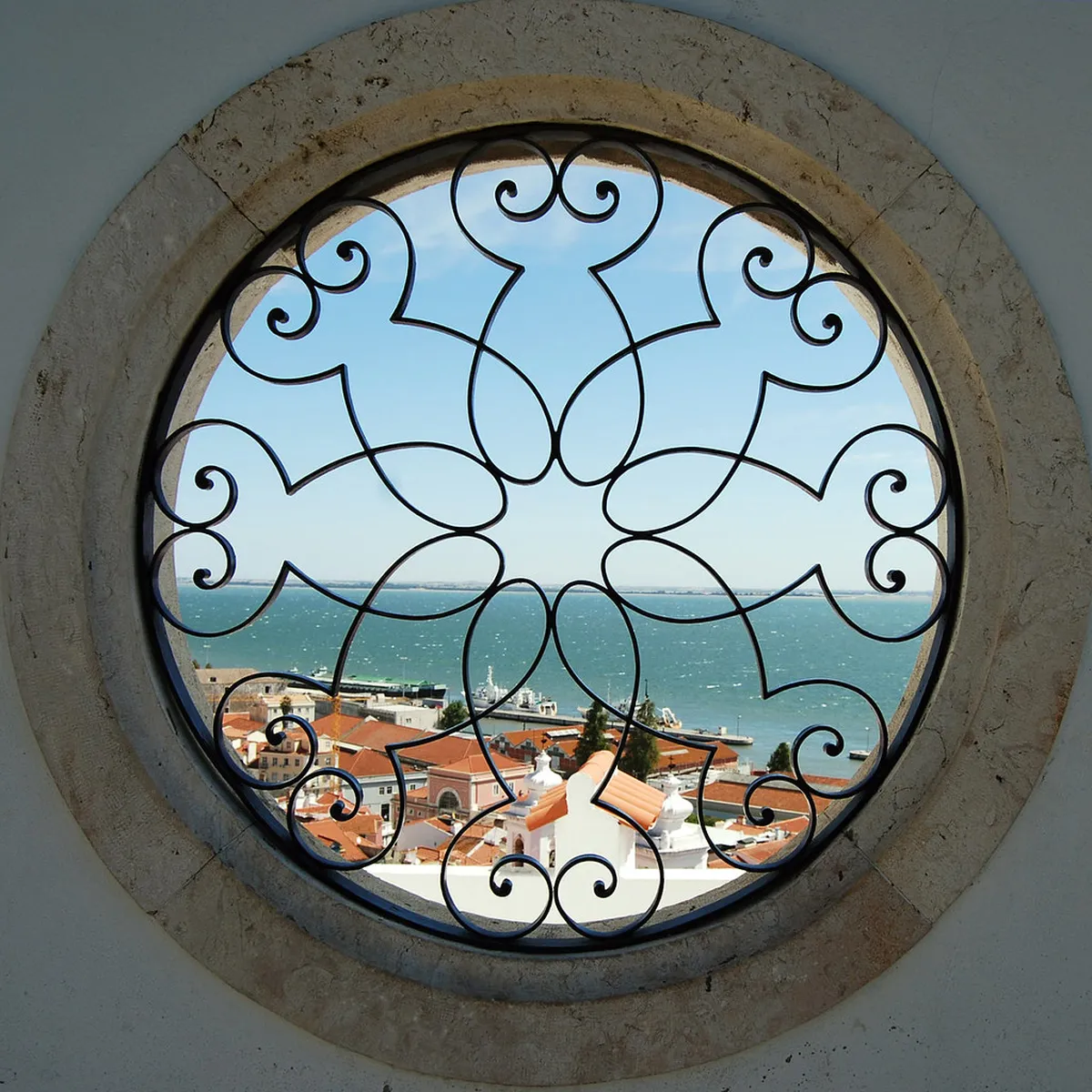
Alfama survived the 1755 earthquake that destroyed most of Lisbon, which is why its medieval street plan still reads like no other district in the city. The narrow lanes, tiled facades, and yellow trams that climb its slopes are not set dressing — they are a working neighbourhood that happens to photograph exceptionally well. This guide focuses on where to stand, when to arrive, and exactly what to frame at each location.
We have organised the spots so you can walk them as a single morning circuit starting at 07:00. That window — roughly 07:00 to 09:30 — is when the light is soft, the tram is running, and the tourist coaches have not yet parked below the viewpoints. Bring comfortable grip shoes. Alfama's calçada portuguesa cobblestones become dangerously slick in any moisture.
Miradouro de Santa Luzia: The Azulejo Terrace
Santa Luzia is the most famous terrace in Alfama, and for good reason. The viewpoint's back wall is lined with large blue-and-white azulejo tile panels depicting Lisbon before the 1755 earthquake — the tiles themselves are one of the strongest compositional subjects at the site, entirely separate from the panoramic view. Arrive before 08:00 to photograph the tile panels without shoulders and selfie sticks in the foreground.
For the vista, position yourself at the iron railing along the south edge. The red rooftops of lower Alfama stack down the hill toward the Tagus, with the dome of the National Pantheon visible to the left. This is the classic postcard angle. At golden hour the light enters from the east in summer (roughly 06:20 in June), catching the upper facades before touching the valley — shoot from the railing in the first fifteen minutes of direct sun for warm shadows in the lanes below.
The bougainvillea-draped pergola on the west side provides a natural frame for portrait and detail shots. The terrace is free, open 24 hours, and sits on Rua de Santa Luzia — walk up from Largo das Portas do Sol in under two minutes.
Miradouro das Portas do Sol: River Panorama and Tram Convergence
Portas do Sol sits just east of Santa Luzia and offers a wider, less obstructed view of the Tagus. The statue of São Vicente — Lisbon's patron saint — stands at the centre of the terrace and gives any wide shot a natural focal point. The light in summer mornings hits the river straight on, producing strong reflections that work well with a polarising filter.
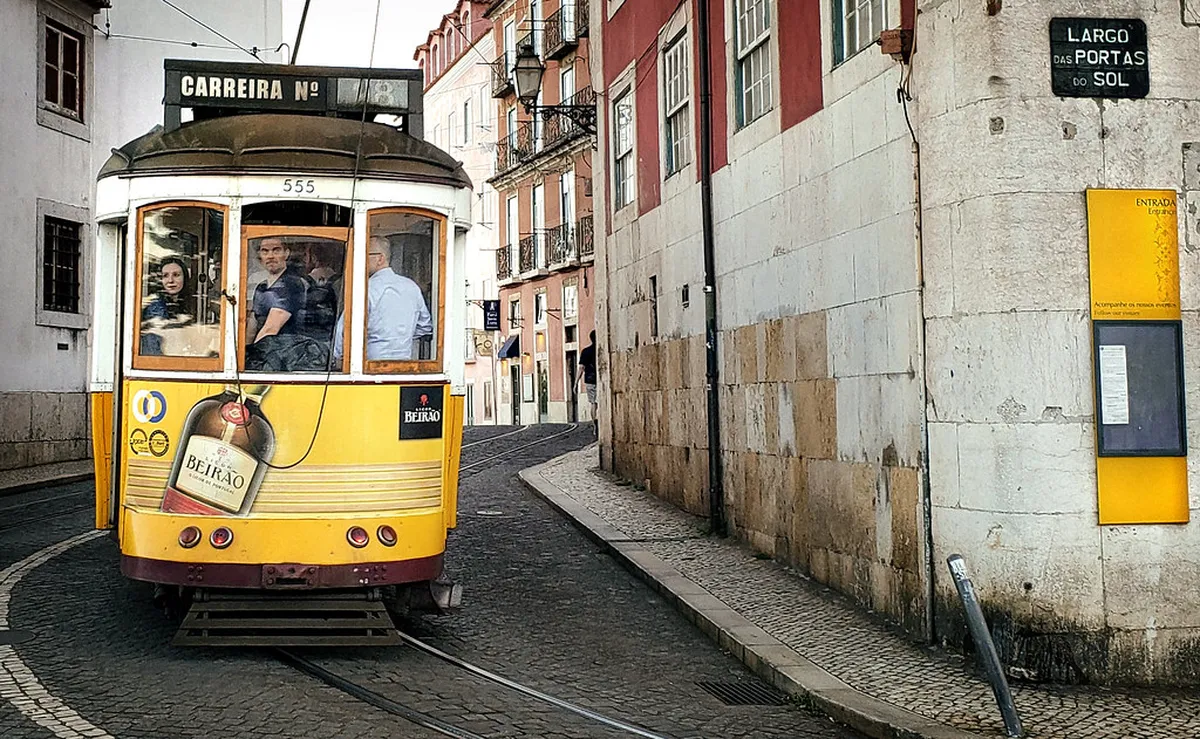
This is also one of the two best spots to watch Tram 28 pass at low speed through the square. The tram slows considerably as it rounds the corner from Rua de Santa Luzia, giving you a two-to-three-second window for a motion-blur frame at 1/30s or a clean sharp shot at 1/500s. Service starts at approximately 07:00; the first two runs of the day carry almost no passengers, which keeps the windows clear for interior shots if you position correctly on the pavement.
Access is free and the terrace is open at all times. A café on the north side opens by 08:00 and is useful for a mid-morning break before walking further up the hill.
Calçada de São Vicente: The Best Tram 28 Street Shot
Every photographer in Alfama wants the yellow tram on a narrow cobblestone street. Calçada de São Vicente — the steep lane running north from the Sé Cathedral area toward the church of São Vicente de Fora — is the single best location for this shot in the entire district. The street is tight enough that the tram nearly fills the frame from side to side, with laundry lines and potted plants on the upper balconies providing depth.
The constraint is timing. You need to be in position before 08:00 because the light on this east-facing street disappears into harsh overhead sun by mid-morning. Stand roughly 40 metres south of the São Vicente stop and compose at about 50mm equivalent focal length. The tram arrives every 10 to 15 minutes on this section; check the Carris app for real-time position. The ride itself costs €3.00 per single journey in 2026 if you tap with a Viva Viagem card — buying onboard costs €4.00.
Do not attempt tripod setups here after 09:00. The street narrows to barely two metres in places and becomes a pinch point for pedestrians and delivery vehicles. A monopod is a better tool on this street than a full three-leg setup.
Sé de Lisboa: Finding the Clean Cathedral Shot
The Lisbon Cathedral is the oldest building in the city and the anchor of every wide shot of lower Alfama. Every photographer wants the Tram 28 passing in front of its Romanesque facade. The problem is that the standard shooting position — directly opposite the main door on Rua Augusto Rosa — is blocked by overhead tram cables, a line of parked vehicles, and often a tourist bus stopped at the kerb.
The cleaner frame is found by walking roughly 30 metres west along Rua Augusto Rosa to the small triangular traffic island. From here the facade opens up at a slight angle, the cables are fewer, and the tram enters the shot from the right rather than sitting dead-centre under the most obstructive cable run. Use a focal length of 24 to 35mm equivalent and stop down to f/8 to keep the stonework sharp across the full width.
Interior access to the nave is free. The Gothic cloister and treasury cost approximately €5 per adult and are open Monday through Saturday 10:00 to 18:00. The interior columns and vaulted ceiling reward a wide-angle lens at ISO 800 to 1600 in the available light — no flash is permitted.
Beco de Santa Helena: The Viewpoint Competitors Miss
Most photography guides for Alfama start and end with Santa Luzia and Portas do Sol. Beco de Santa Helena, a short lane that opens onto a wider terrace a few hundred metres northeast, consistently delivers better compositions for one specific reason: from here you can include the Mosteiro de São Vicente de Fora in the background of your Alfama rooftop shots. The monastery's twin white towers read clearly from this angle, adding architectural variety that the other two viewpoints lack.
The terrace is smaller and less signposted, which means it is materially quieter even at peak hours. In the early morning — before 08:30 — it is frequently empty. The light in summer falls on the monastery facade from the east, so arrive early rather than at golden hour to get direct illumination on the white stone. A 70 to 100mm equivalent focal length lets you compress the rooftop layers with the monastery towers in the background.
There is no café, no facilities, and no entrance fee. To reach it, walk north from the Portas do Sol terrace for about five minutes following Rua de São Tomé, then look for the lane signs on the left. It is easy to miss on a first visit.
Narrow Alleys and Laundry Lines: Street-Level Alfama
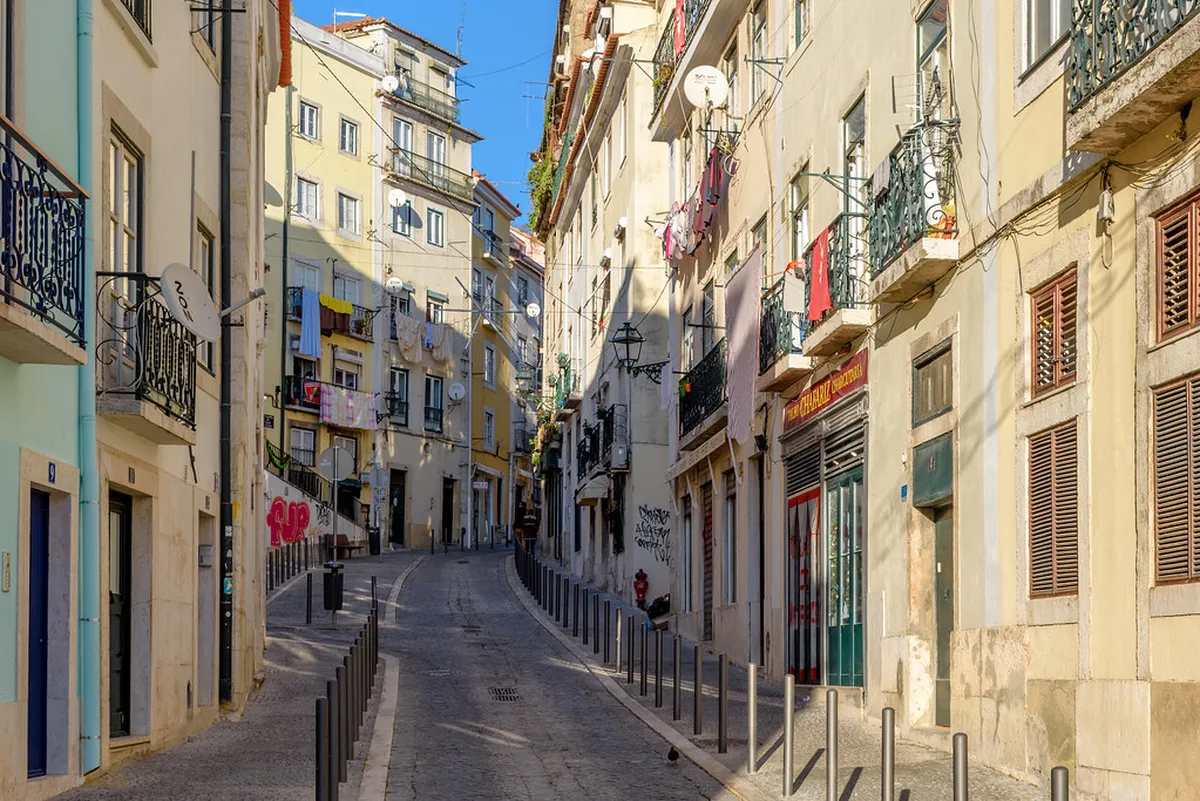
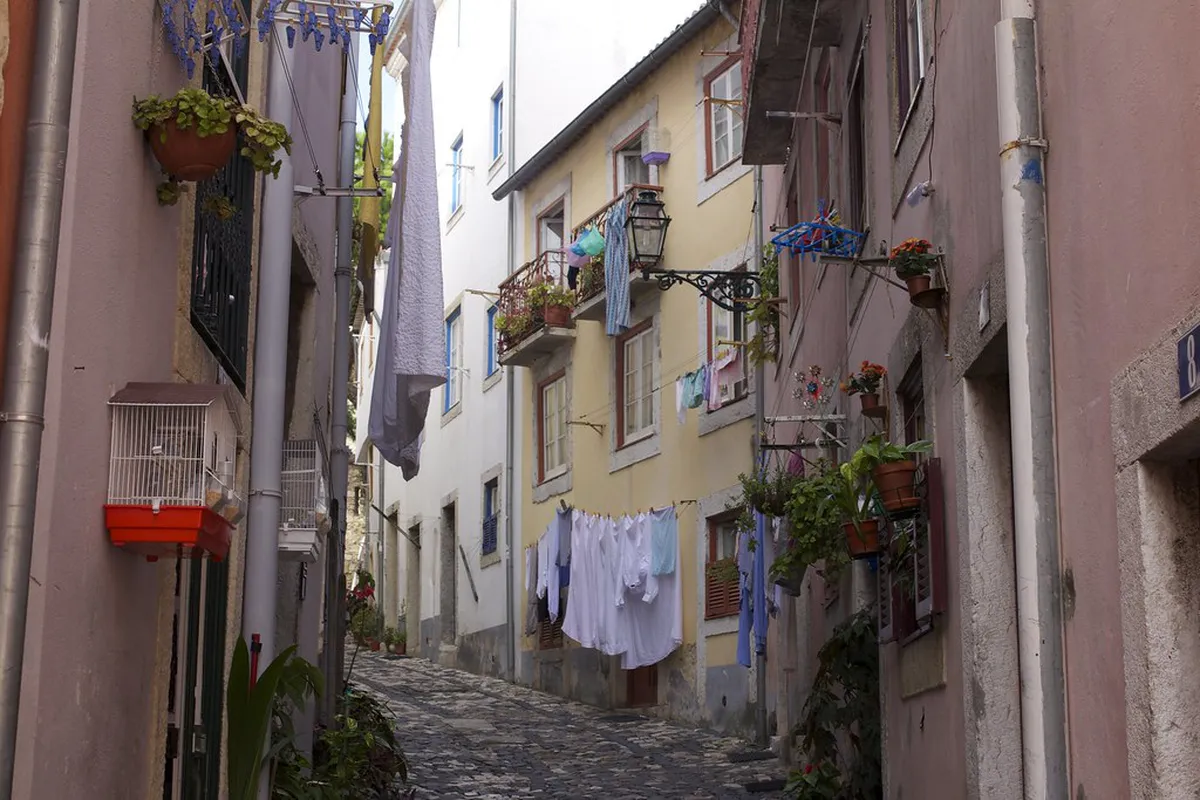
The most distinctive street-level images from Alfama feature laundry strung across the lane overhead, coloured azulejo tiles on doorframes, and the sharp geometry of stairways dropping between ochre walls. Beco de Santa Helena and the lanes immediately south of Largo do Intendente are the most concentrated areas for this kind of shot, but the honest approach is to walk without a fixed destination and react to what appears.
A 35mm equivalent focal length is the most useful for narrow passages — wide enough to show the lane and the sky above, tight enough to isolate a doorway or window. Shoot in the first two hours after sunrise when the low angle produces long shadows that add depth to the flat planes of the walls. Avoid flash at any time; it washes out the texture that makes these walls interesting and disturbs residents who live behind those doors.
Always ask before photographing people at close range. Many of the people you will encounter are elderly residents who have lived in these streets for decades. A gesture and a nod is usually sufficient. Be respectful and you will often be welcomed back through a front door for a courtyard shot that no tourist app will ever surface.
Azulejo Tiles: A Dedicated Photography Subject
Lisbon's coloured ceramic tiles are among the most photographed surfaces in Portugal, and Alfama concentrates them more densely than any other district. The tiles are not just decorative — they tell local history. Look for panels that depict saints' days, maritime scenes, or geometric patterns handed down from Moorish architecture. The Santa Luzia viewpoint's back wall, already mentioned, is the single most famous tile panel in the area. But the real finds are the building facades on the smaller streets running off Rua dos Remedios.
For detail shots, use a macro or short telephoto focal length (around 85 to 100mm equivalent) and position yourself square to the wall to avoid keystoning. Overcast days are actually better for tile photography than sunny mornings because the even diffuse light reveals the glaze texture without specular reflections. If you visit on a cloudy day, redirect your schedule toward tile hunting rather than fighting flat light at the viewpoints.
One underrated stop is the exterior wall of Igreja de São Vicente de Fora on Largo de São Vicente. Its full-width tile panels illustrating the fables of La Fontaine are museum quality and can be photographed for free from the public square. The interior cloister — also extensively tiled — costs €5 to enter and is open Tuesday through Sunday 10:00 to 18:00.
Castelo de São Jorge: 360° Rooftop and Pine-Shaded Walls
São Jorge Castle sits on the highest point of the Alfama hill and gives the only location in the district with a true 360-degree view — east toward the National Pantheon, south over the Tagus, west to the 25 de Abril Bridge, and north toward the Serra de Sintra on clear days. The battlements and stone towers also work as textural foreground for wide shots, which the open-terrace miradouros cannot offer.
Arriving an hour before sunset puts you inside when the ticket desks are still open and gives you time to reach the upper battlements before the light changes. Adult tickets cost €15 in 2026; the castle is open daily from 09:00 to 21:00 between June and September. The pine-shaded courtyard is the best spot for portrait photography in soft dappled light during the middle of the day when the open viewpoints are harsh and crowded.
One structural note: the interior is rougher underfoot than the city streets. Tripods work well on the flat stone sections of the upper ramparts, but be cautious near the edge — the parapets vary in height. A 16 to 35mm zoom covering both the tight courtyard spaces and the wide-angle panoramas from the towers is the most efficient single lens to bring here.
The Alfama Festivities: When the Streets Transform
Every June, Alfama celebrates the Festas dos Santos Populares — particularly the feast of Santo António on the night of 12–13 June. The streets are hung with paper streamers, coloured lights, and sardine bunting. Tables appear in the lanes. Fado musicians and accordion players perform from doorways. This is categorically the best single photographic event in the district all year.
From a technical standpoint, the festivities require a different approach than daytime shooting. The light sources are mixed — warm tungsten strings overhead, open flame from grills, neon shop signs — so shoot in RAW and set a custom white balance or correct per-shot in post. ISO 3200 at f/2.8 with a 35mm lens is a workable baseline. The crowds are dense enough that a 50mm or wider is more practical than a telephoto.
The neighbourhood feels genuinely different during these days in a way that no amount of returning in July will replicate. The residents and the tourists coexist at street level rather than observing each other at a distance. If your travel window overlaps with mid-June, prioritise this over any other photography activity in Lisbon. For the full cultural context of what you are photographing, our Alfama complete district guide covers the neighbourhood's history and traditions in detail.
Miradouro da Graça: The Quieter Golden-Hour Alternative
Santa Luzia and Portas do Sol are well known. Miradouro da Graça, a ten-minute walk further uphill, is less frequented at golden hour for one simple reason: most people do not want to climb the extra elevation after a full morning of shooting. That reluctance works in your favour. At 19:00 on a summer evening, Graça typically has a fraction of the crowd of the two lower viewpoints, with no tour groups and usually enough railing space to set up a tripod without negotiating with anyone.
The view from Graça faces southwest, making it the correct orientation for a Lisbon sunset — the light falls directly onto the Castelo de São Jorge to your right and the river opens up ahead. On clear evenings in June and July, sunset occurs between 21:00 and 21:20, which means the golden hour starts around 20:00. Plan your ascent accordingly and allow yourself time at the top before the light peaks.
The Miradouro da Graça is free and accessible at all hours. The Igreja da Graça next to it closes by 19:00 on weekdays but provides a useful landmark for navigation. From Largo da Graça there are direct bus connections back down to Martim Moniz if you do not want to walk the hill in the dark after a long day's shooting. See our guide to the wider Portugal region for planning the rest of your photography itinerary beyond Lisbon.
How to Plan Your Alfama Photo Walk in 2026
A practical morning circuit runs as follows: arrive at Calçada de São Vicente by 07:00 for the tram shot in clean early light. Walk south to the Sé Cathedral and use the triangular island position for the Tram 28 facade frame. Continue uphill along Rua Augusto Rosa to Largo das Portas do Sol, covering both the Portas do Sol terrace and Santa Luzia by 08:30. Then walk north to Beco de Santa Helena before the terrace fills. By 09:30, drop back to the alley network around Rua dos Remedios for street-level and tile shots when the sun angle is lower and less harsh through the gaps between buildings.
For gear, a lightweight 24–70mm f/2.8 equivalent covers the full range from alley claustrophobia to terrace panoramas. A circular polariser cuts Tagus glare from the miradouros. A small lightweight tripod or Gorillapod earns its weight at the castle and for any long exposures at Portas do Sol. Bring cash — many of the small cafes that serve the best pastel de nata in the district are cash-only, and you will want the coffee after the uphill sections.
Most outdoor locations in Alfama are free. Budget for São Jorge Castle (€15), the National Pantheon (€8), and the São Vicente de Fora cloister (€5) if you want to photograph interiors. Transport on Tram 28 is €3.00 per single with a Viva Viagem card. Total cost for a full Alfama photography day including transport, one paid interior, and meals runs roughly €30 to €45 per person in 2026.
In summer (June), golden hour light enters from the east at roughly 06:20. Position yourself at the iron railing at Santa Luzia in the first fifteen minutes of direct sun to capture warm shadows in the lanes below. This narrow window is essential for the signature Alfama rooftop shots.
Arrive at Santa Luzia before 08:00 to photograph the tile panels and viewpoints without crowded tourists and selfie sticks. If the main viewpoints feel too busy, Miradouro da Graça is typically less frequented at golden hour—a ten-minute climb rewards you with nearly empty railing space and room to set up a tripod without negotiating.
| Spot | Best shot | Best time |
|---|---|---|
| Miradouro de Santa Luzia | Azulejo tile panels and rooftop vista with Tagus below | Before 08:00 (sunrise light) |
| Miradouro das Portas do Sol | Wide river panorama with São Vicente statue and Tram 28 | 07:00–08:30 (morning light) |
| Calçada de São Vicente | Yellow Tram 28 filling the narrow cobblestone street | Before 08:00 (east-facing light) |
| Sé de Lisboa | Cathedral facade with Tram 28 from triangular island position | 07:00–08:30 (clean morning light) |
| Beco de Santa Helena | Rooftops with Mosteiro de São Vicente towers in background | Before 08:30 (east-facing monastery facade) |
| Castelo de São Jorge | 360° panorama from battlements and pine-shaded courtyard portraits | Golden hour (start ~20:00 in June) |
| Miradouro da Graça | Sunset over Castelo and river with minimal crowds | 19:00+ (sunset golden hour) |
Frequently Asked Questions
What is the best time of day for photography in Alfama?
Sunrise is the best time for Alfama photography. The light is soft, the colors are vibrant, and the streets are mostly empty of tourists. Most tour groups arrive after 10:00 am, so early sessions are essential for clean shots.
Are tripods allowed in the Alfama district?
Yes, tripods are generally allowed in public spaces like viewpoints and streets. However, they can be difficult to use in narrow alleys where they block pedestrian traffic. Be mindful of residents and keep your setup compact in tight corridors.
How much does it cost to visit the best photo spots?
Most of the best spots, including the famous miradouros and winding alleys, are free to visit. Major landmarks like the Castle or the National Pantheon charge between €8 and €15. Riding the tram costs about €4, but photographing it from the street is free.
Alfama rewards photographers who are willing to climb past the obvious viewpoints and sit quietly in a lane until the light changes. The district's combination of medieval street layout, azulejo tiles, yellow trams, and proximity to the river produces conditions that are genuinely difficult to find anywhere else in Europe. The spots in this guide are all accessible in a single morning — but you will almost certainly return a second day once you have seen what the golden hour does to the rooftops from Graça.