On the morning of All Saints' Day, November 1, 1755, Lisbon was a city at prayer. Thousands of residents filled churches across the old quarters for morning mass, candles lit at every altar. At approximately 9:40 in the morning, everything changed. The ground shook violently in waves, collapsing walls, toppling bell towers, and burying entire streets under heavy stone rubble within minutes.
The 1755 lisbon earthquake impact old quarters did not end with the tremors. Fires broke out across the city, fed by the overturned candles and cooking hearths of a densely built medieval capital. Roughly forty minutes after the quake, a massive tsunami surged up the Tagus River, drowning thousands who had fled to the waterfront. Understanding the oldest neighborhoods in Lisbon means confronting this triple disaster and its extraordinary aftermath.
The 1755 Disaster: Earthquake, Tsunami, and Fire
Seismologists estimate the earthquake at magnitude 8.5 to 9.0, comparable in power to the 2004 Sumatra-Andaman earthquake. The shaking lasted between three and six minutes in two or three distinct waves. That duration alone set it apart from typical seismic events — buildings that might have survived a shorter tremor had time to progressively weaken and collapse. Most of the city's grandest Manueline palaces, Gothic churches, and Renaissance convents fell in that first morning.
The fires that followed burned for nearly a week. Because November 1st was a major feast day, every church had lit hundreds of candles before the quake struck. Fallen timbers, open hearths, and coastal winds fanned the flames through the densely packed lower city. Historical accounts suggest fire destroyed more buildings than the initial earthquake, consuming libraries, royal archives, and artwork accumulated during Portugal's Golden Age of exploration.
The tsunami delivered the final blow. The sea withdrew dramatically before the waves arrived — a phenomenon that drew curious crowds to the waterfront, where they were then killed. Three distinct waves struck the Tagus estuary, the second being the most destructive. Estimates of total casualties range from 30,000 to 60,000 in the Lisbon region alone. Smaller towns along the Alentejo and Algarve coasts suffered proportionally even greater destruction. The event remains one of the deadliest natural disasters in recorded European history.
King José I survived because his court had left Lisbon for Belém the previous evening. His chief minister, Sebastião José de Carvalho e Melo — later granted the title Marquês de Pombal — arrived at the ruins and immediately took command. When asked what should be done, he is said to have replied: "Bury the dead and feed the living." Within days he had established emergency relief, organized rubble clearance, and set the framework for the most ambitious urban reconstruction Europe had seen in a century.
When the 1755 tsunami struck, thousands who had fled to the Tagus waterfront to escape the earthquake were killed by the waves. Three distinct surges hit the estuary — the second being the most destructive. Modern Lisbon's riverside promenades are safe, but this history is worth knowing before you visit Praça do Comércio near the water's edge.
Baixa Pombalina: The Birth of Modern Urban Planning
The Marquês de Pombal rejected every proposal to relocate Lisbon to a new site. He chose instead to rebuild the destroyed valley exactly where it had stood, but according to a rational Enlightenment grid rather than the organic medieval layout that the earthquake had erased. Chief engineer Manuel da Maia presented several plans; Pombal selected the most radical option, which swept away the old street network entirely and replaced it with parallel avenues intersecting at right angles.
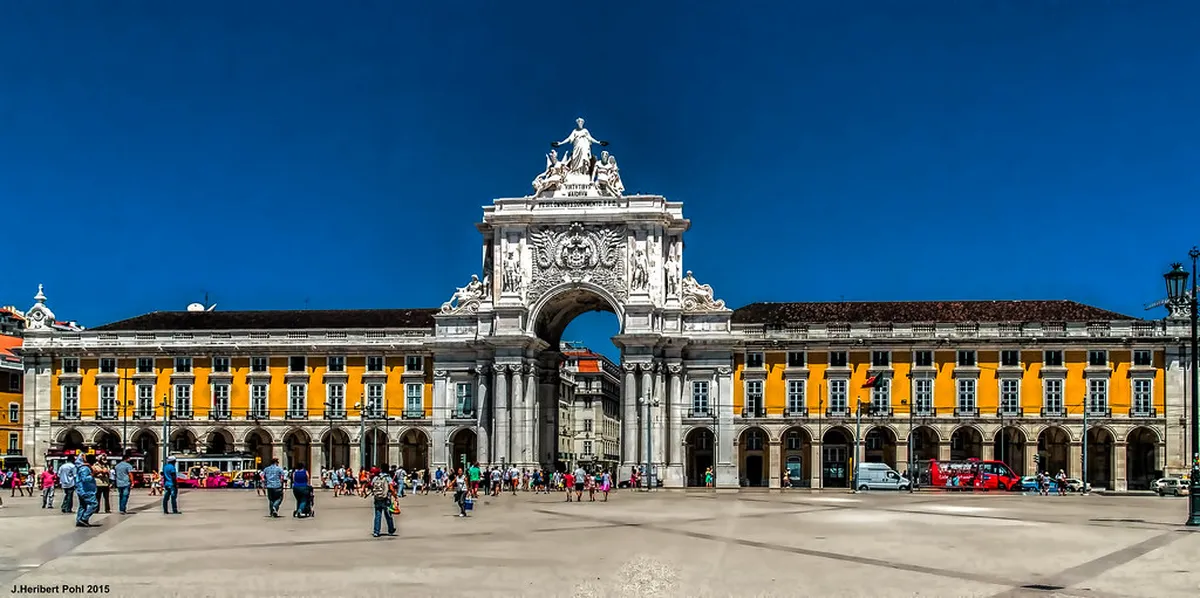
Strict royal decrees governed every building in the new Baixa Pombalina. Facades had to reach a uniform height of four storeys. Window openings, cornice heights, and decorative elements were standardized so that an entire block could be constructed rapidly using prefabricated components. The result is the only large-scale Enlightenment urban grid in the Iberian Peninsula — and it is still largely intact today. You can see the rebuilding of the Baixa expressed in every straight avenue and matching yellow facade.
The practical benefits were immediate. Wider streets allowed faster movement of goods and emergency response. Open squares at either end — Rossio to the north and Praça do Comércio to the south — gave the city two grand civic lungs. The new layout also separated commercial uses from residential ones for the first time, with streets named after the trades that occupied them: Rua da Prata (silver), Rua do Ouro (gold), Rua dos Sapateiros (shoemakers). Many of those names survive in 2026.
| Feature | Pre-1755 Baixa | Post-1755 Baixa Pombalina |
|---|---|---|
| Street layout | Narrow, winding medieval alleys | Wide grid with parallel avenues at right angles |
| Building heights | Irregular, no standardization | Uniform four-storey facades by royal decree |
| Fire separation | None — densely packed with shared timber walls | Wider streets and open squares acting as firebreaks |
| Seismic design | Masonry only, no earthquake resistance | Gaiola Pombalina flexible wooden cage inside every wall |
| Completion timeline | Built over centuries organically | Rebuilt to essential plan within 20 years of disaster |
- Pre-1755 Baixa used narrow, winding medieval alleys with no fire separation between buildings
- Post-1755 Baixa introduced a wide grid system, uniform building heights, and open squares at each end
- Old construction relied on masonry alone with no seismic design; new construction embedded flexible wooden frames inside every wall
- The new district was completed to its essential plan within twenty years of the disaster
Chiado's Transformation: From Ruins to Cultural Hub
The Chiado district suffered immense damage because of its location on a steep hill directly above the fire's path through the Baixa. Wealthy families and religious orders lost their grand palaces and churches in the combined assault of earthquake and flame. Reconstruction was slower here than in the flat Baixa valley because the terrain made standardized grid planning impossible. Instead, architects adapted Pombaline principles to the hillside, producing a district that is orderly but not uniform.
By the nineteenth century, Chiado had become the intellectual and commercial center of Lisbon. The historic Chiado district filled with sophisticated bookshops, literary cafes, and theaters catering to the city's educated elite. A Brasileira cafe at Rua Garrett 120, opened in 1905, became the meeting point for writers and poets including Fernando Pessoa, whose bronze likeness still sits at an outdoor table. The statue is one of the most photographed objects in modern Lisbon.
Modern Chiado serves as a bridge between the commercial Baixa below and the bohemian Bairro Alto above. Luxury boutiques and restored theaters make it one of the most expensive retail addresses in Portugal. In 1988, a second major fire tore through a large section of Chiado, destroying several historic buildings that had survived 1755. Architect Álvaro Siza Vieira led the subsequent restoration, carefully preserving the district's Pombaline and nineteenth-century character while updating the interiors for contemporary use. His approach — maintaining facades and massing while replacing interiors entirely — has since become a model for urban fire recovery across Europe.
Alfama and Mouraria: Why the Oldest Quarters Survived
While the valley collapsed, the winding streets of Alfama remained largely standing. The primary reason lies deep beneath the surface of the hills. Alfama sits on a solid foundation of hard limestone and volcanic basalt bedrock. This dense stone transmitted seismic energy very differently from the soft alluvial and marine sediments deposited over centuries in the Baixa valley below.
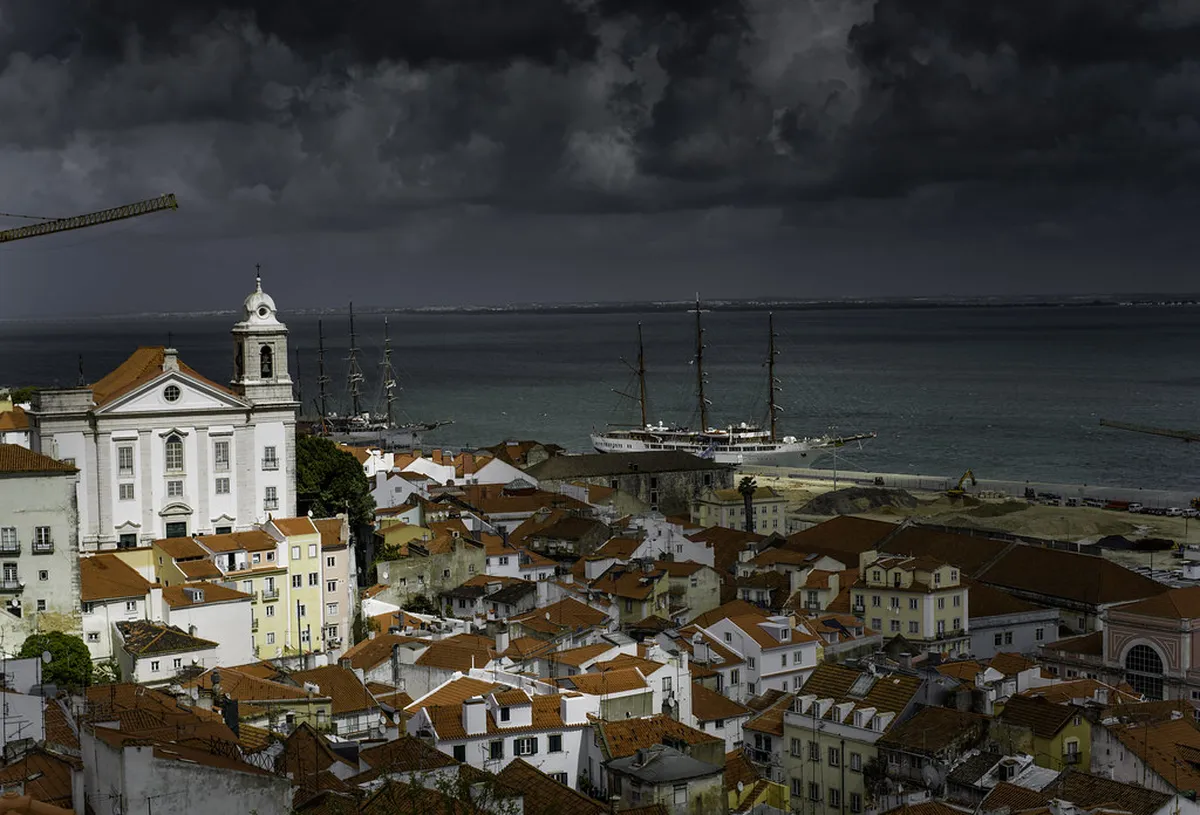
Soil conditions amplify or dampen earthquake waves depending on their composition. Loose, water-saturated sediments in a low-lying basin can amplify ground shaking by a factor of four or five compared to solid bedrock. The Baixa valley floor was built on exactly that kind of sediment — former marshland and tidal flats reclaimed from the Tagus over the preceding centuries. Alfama's basalt, by contrast, barely resonated. The same seismic energy that flattened stone mansions in the valley caused only minor cracking in the hilltop quarters above.
The Mouraria neighborhood also benefited from this stable geological positioning. Buildings in both areas were smaller and more tightly packed, with party walls providing mutual bracing. The narrow alleys prevented the kind of catastrophic progressive collapse that swept through wider streets when facade walls fell outward. Many residents in these quarters survived because their homes simply did not have enough mass to kill them when they cracked.
Exploring Alfama and Mouraria today offers a glimpse into what Lisbon looked like before 1755. The medieval street pattern — organic, uphill, impossible to navigate without getting lost — is the direct opposite of the Pombaline grid below. The survival of these quarters also preserved the social conditions that sustained traditional Fado music: the close-knit community life, the shared courtyards, and the rootedness in place that the earthquake erased everywhere else.
The Gaiola Pombalina: World's First Anti-Seismic Buildings
The most technically significant outcome of the 1755 reconstruction was the Gaiola Pombalina — the Pombaline Cage. Engineers under Pombal's direction devised a flexible wooden skeleton built inside masonry walls. The frame consists of vertical posts, horizontal ties, and diagonal braces arranged in a Saint Andrew's cross pattern. That diagonal is the key: it converts horizontal seismic forces into compressive loads that the timber can absorb and redistribute without snapping.
The design was tested by marching troops around scale models to simulate ground vibration. This proto-seismic testing was unprecedented in European building practice. When the frame worked in models, it was standardized across every new building in the Baixa, allowing rapid prefabrication. Carpenters could assemble the cage elements off-site and install them quickly, which was critical given the need to house tens of thousands of displaced residents before another winter arrived.
The Gaiola performed well in subsequent smaller earthquakes, including tremors in 1858, 1903, and 1969. Buildings constructed with the cage showed dramatically less damage than comparable masonry structures of the same era. Modern structural engineers still study the system: the Saint Andrew's cross bracing anticipates techniques that only became standard in earthquake-resistant construction worldwide during the twentieth century. You can sometimes see the wooden frame exposed during building renovations in the Baixa, visible in the cavity between old brick and modern plaster.
Today the Gaiola is legally protected. Lisbon's city government requires that any renovation of a Pombaline building preserve the original wooden cage structure even when the rest of the building is modernized. This makes these buildings uniquely expensive to restore but ensures that the city's first systematic response to seismic risk remains intact nearly 270 years after it was built.
How the Earthquake Shook Enlightenment Philosophy
The 1755 disaster arrived at a critical moment in European intellectual history. Enlightenment thinkers had been arguing that the universe was rationally ordered, benevolent, and ultimately good — the position Leibniz called "the best of all possible worlds." The destruction of Lisbon, a devout Catholic city, on the holiest morning of the year, killing tens of thousands in churches, seemed to demolish that argument with physical force.
Voltaire responded within weeks with his Poème sur le désastre de Lisbonne, published in 1756. The poem attacked optimistic theodicy directly: how could a rational, just God permit the annihilation of an innocent city? He later sharpened the critique in Candide (1759), using the earthquake as the pivot around which his satirical dismantling of optimism turns. Pangloss, the Leibnizian philosopher, watches Lisbon burn and continues to insist that all is for the best — a position that Voltaire renders absurd through accumulating horror.
Immanuel Kant, then a young lecturer in Königsberg, took a more empirical approach. He published three essays on the Lisbon earthquake between 1756 and 1757, attempting to explain it through natural causes — plate movements, subterranean cavities, underground gases. Kant's response was remarkable less for its geological accuracy (it was largely wrong) than for its insistence that natural disasters must be studied scientifically rather than interpreted theologically. The earthquake pushed Kant toward the secular, rational framework that would eventually underpin his Critiques.
For visitors to Lisbon today, this philosophical dimension adds an unexpected layer to an already charged landscape. The Baixa grid you walk through is not just an urban planning decision — it is a built argument that human reason can respond to catastrophe, that cities can be redesigned rather than abandoned to fate. Pombal's reconstruction was itself an Enlightenment project, as deliberate and ideological as any text published in Paris or Königsberg that same decade.
Praça do Comércio and the Royal Palace Legacy
Before the earthquake, the grand Ribeira Palace stood where the Praça do Comércio is now. It was one of the largest royal complexes in Europe, housing not only the court but a substantial library, an art collection, and the royal archives. The tsunami and fire erased it completely in a matter of hours. King José I was so traumatized by the disaster that he developed a permanent fear of enclosed stone buildings and spent the rest of his reign in a sprawling encampment of royal tents and lightweight structures at Ajuda on Lisbon's outskirts.
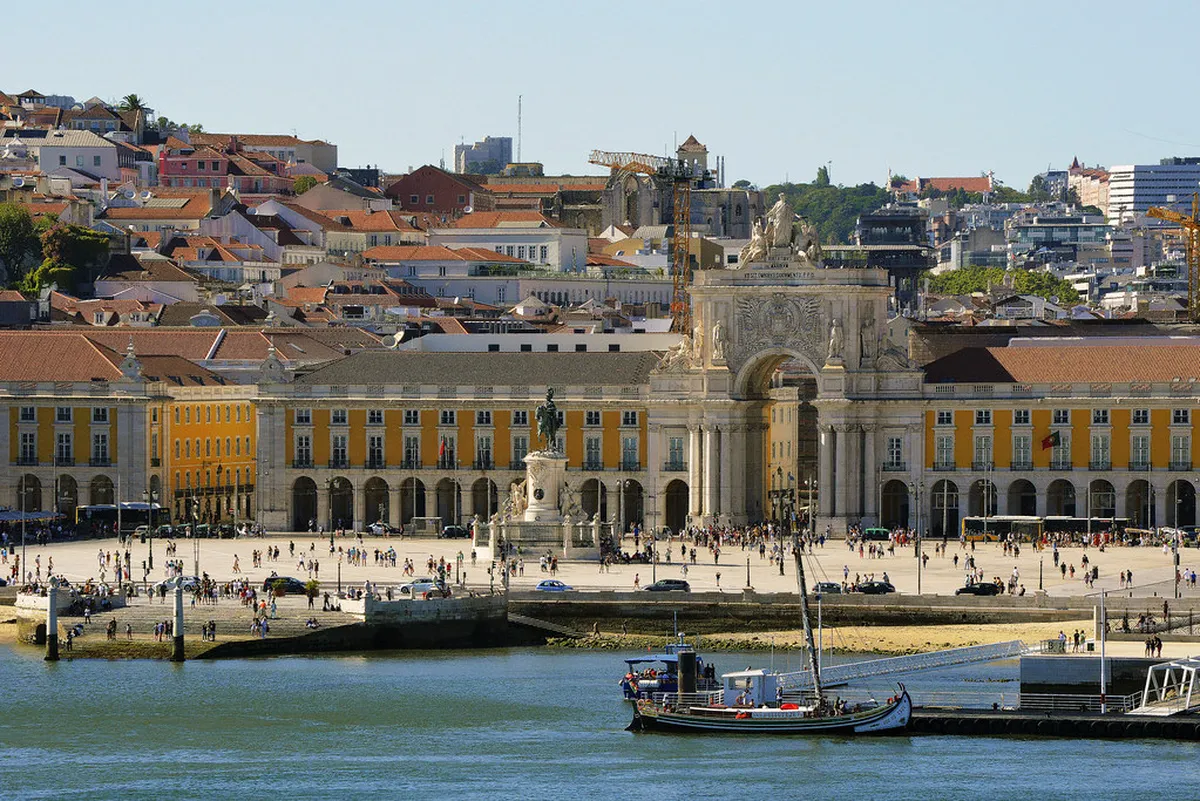
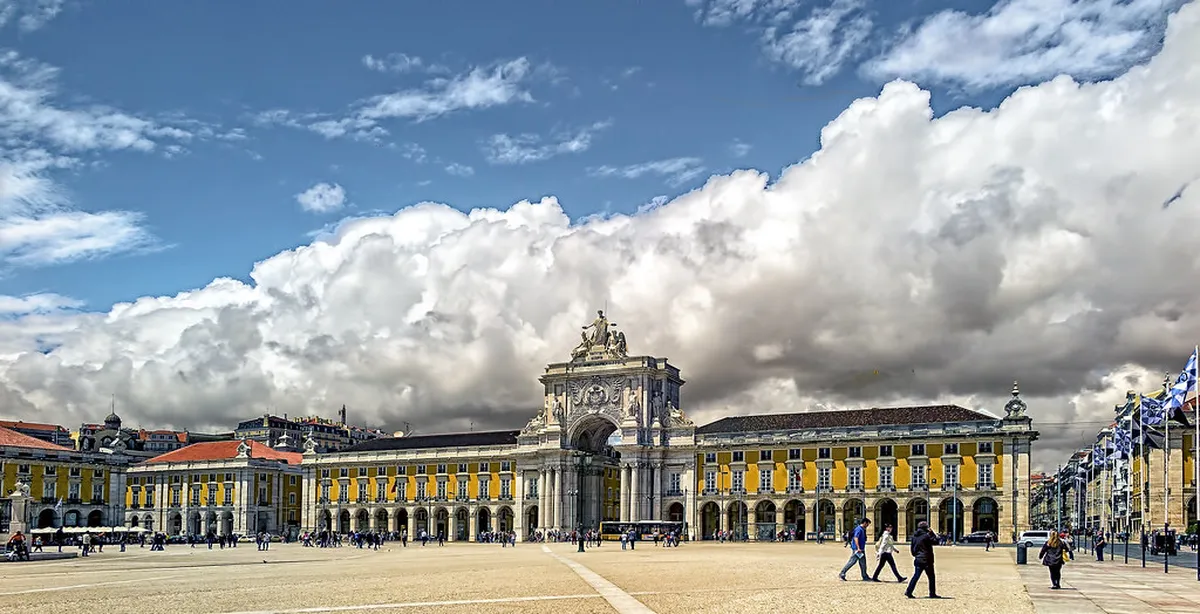
Pombal designed the new square as a deliberate statement of state power and commercial confidence. Rather than rebuilding a palace, he created an open waterfront plaza flanked by government ministries and surrounded by uniform ochre arcades. The river-facing side was left fully open — partly to maximize the view across the Tagus, partly as an acknowledgment that no wall could have stopped the 1755 tsunami. The square's new name, Praça do Comércio (Commerce Square), signaled the shift from royal residence to mercantile republic.
The bronze equestrian statue of King José I at the center, completed in 1775, was designed by sculptor Joaquim Machado de Castro. José I refused to pose for the work, so Machado de Castro relied on coins and other likenesses. The king's plumed helmet was deliberately emphasized to draw attention away from the face. A bronze medallion of the Marquês de Pombal appears on the pedestal — a subtle reminder of who actually rebuilt the city. Walking through the Rua Augusta Arch into the square provides the most dramatic entry point, framing the Tagus at the far end in a composition that Pombal's architects calculated very carefully.
Rossio Square: The Heart of Post-Quake Lisbon
Rossio Square has served as Lisbon's main public gathering place since the Middle Ages, and the 1755 earthquake was not enough to dislodge it from that role. The Grand Hospital and the Estaus Palace that had bordered the square were destroyed; Pombal's team rebuilt the northern edge with the Teatro Nacional Dona Maria II, which now occupies the site of the old Inquisition tribunal. The change is deliberate: from an institution of religious coercion to a venue of secular culture.
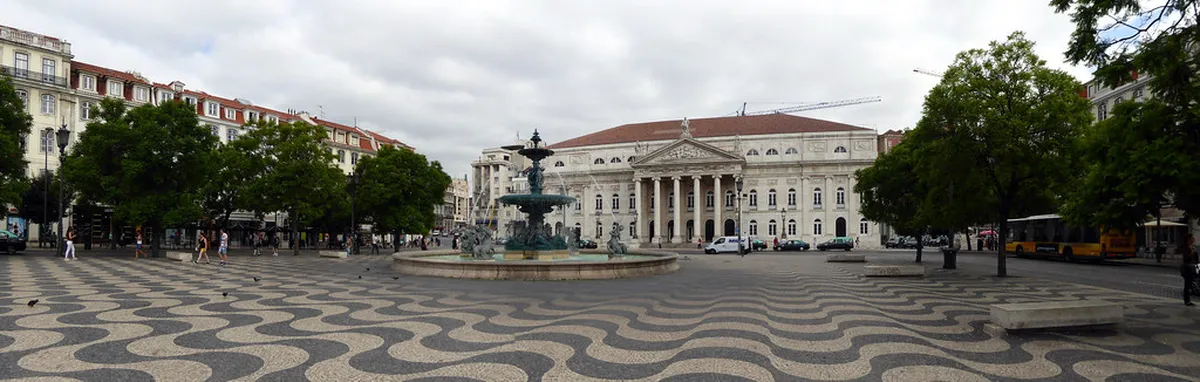
The famous wave-patterned stone pavement — calçada portuguesa — was added during the nineteenth century, long after the initial reconstruction. The pattern uses small limestone and basalt cubes arranged to suggest ocean waves, connecting the city visually to its maritime identity. An 89-foot column topped by a bronze statue of Pedro IV, installed in 1870, presides over the center of the square. At the base, four allegorical figures represent Justice, Wisdom, Strength, and Moderation. Two elaborate bronze fountains imported from France and installed in 1889 anchor the north and south ends.
Today Rossio connects the Baixa to the grand Avenida da Liberdade and is the busiest pedestrian junction in central Lisbon. Historic cafes line the perimeter; the covered Rossio train station on the square's western edge, built in the 1880s with a Neo-Manueline facade, operates services to Sintra. Sitting at one of the outdoor tables with a bica — the strong, short espresso that became Lisbon's default coffee after a Brazilian entrepreneur introduced quality beans here in the early twentieth century — is the simplest way to watch the city's daily rhythm from the heart of its post-earthquake reinvention.
Tracing the Ruins: Carmo Convent and Visible Scars
The Carmo Convent is the most dramatic physical reminder of the 1755 earthquake still standing in Lisbon. Its roof collapsed onto the congregation during morning mass on All Saints' Day, killing worshippers who had gathered exactly as they did every year. The skeletal Gothic arches still reach toward the open sky, preserved deliberately in their ruined state as a permanent memorial. You can visit the ruins near the São Jorge Castle, accessible via the Santa Justa Lift from the Baixa.
The ruins now house an archaeological museum with a diverse collection spanning pre-Columbian mummies from Peru, Egyptian artifacts, and medieval stonework from the Lisbon region. The decision to preserve the roofless church rather than rebuild it was unusual for the eighteenth century, when most earthquake-damaged structures were either demolished or fully restored. Keeping Carmo in its broken state was an acknowledgment that some losses cannot be repaired — a memorial logic that resonates with how modern cities now treat sites of catastrophe.
Subtler scars appear throughout the older hilltop districts. Look for tilted door frames and uneven walls in the backstreets of Alfama, where the earthquake shifted foundations without collapsing buildings entirely. In some alleys in Mouraria and Graça, you can find stretches of wall where the mortar is clearly older than the surrounding stonework — patched after 1755 but never fully rebuilt. These small repairs tell the story of a city that absorbed a catastrophic blow and kept going rather than starting from scratch. They are invisible to most visitors but legible to anyone who knows what to look for.
The Carmo Convent ruins are accessible via the Santa Justa Lift from the Baixa — a short, scenic ride that deposits you directly at street level beside the skeletal Gothic arches. The lift is free to use as a pedestrian passage (a small fee applies to use the top viewing platform). Plan your visit on a weekday morning to avoid queues at the lift.
Frequently Asked Questions
How did the 1755 earthquake change Lisbon's old quarters?
The earthquake led to the complete redesign of the Baixa valley into a modern grid system. It also introduced the Gaiola Pombalina, the world's first anti-seismic building method. These changes created a safer and more organized city center compared to the medieval layout of the surviving Graça district and Alfama.
Why did Alfama survive the 1755 Lisbon earthquake?
Alfama survived primarily because it sits on a solid foundation of limestone and basalt bedrock. This hard stone ground did not shake as violently as the soft alluvial soil in the Baixa valley. The compact nature of the buildings also provided mutual structural support during the tremors.
Where can you see 1755 earthquake ruins in Lisbon today?
The most iconic ruins are found at the Carmo Convent in the Chiado district. The roofless Gothic church remains standing as a permanent memorial to the disaster. You can also see visible scars like uneven walls and tilted frames in the narrow alleys of Alfama and Mouraria.
The 1755 earthquake was a defining moment that shaped the Lisbon we see today. The city's remarkable recovery showcases the resilience and ingenuity of the Portuguese people. From the ruins of the old quarters rose a modern capital built on Enlightenment ideals. Exploring these historic neighborhoods allows you to witness the triumph of human spirit over disaster.